1 Dutch Oven (My 3-3/4 Quart Le Creuset Dutch Oven is the perfect size for this recipe.)
Ingredients
2Largeturkey thighs; bone in, skin onextra virgin olive oil, salt and pepper
128 oz. cancrushed tomatoes
115 oz. cankidney beans, rinsed
115 oz. canwhole kernel corn, rinsed and drained
1medred bell pepper, chopped
1medyellow onion, chopped
3cloves garlic, minced
4Tbschili powder
1tspground cumin
1tspdried oregano
1/4tspcayenne
2oz. candiced, green chilies
water or chicken broth as needed
salt and pepper to taste
garlic powder to taste for turkey thighs
Instructions
The Night Before: Rub olive oil over turkey thighs. Add garlic powder, salt and pepper to taste. Roast thighs in oven for an hour and a half at 350℉. Cool. After cutting meat from bones, shred, leaving skin (optional). Place meat in a bowl and refrigerate overnight. The Next Day: Seed the bell pepper and chop. Chop onion and mince the garlic, sauteing all three in olive oil 5 to 7 minutes. Add cumin, oregano, chili powder, and salt. Add the turkey meat and tomatoes, kidney beans, green chilies, and corn. Simmer for 45 minutes, adjusting spices to taste.Serve with Carolyne's Bandera cloned cornbread recipe
As we draw to the end of Holy Week, I have spent considerable time reflecting on what is happening today, particularly in America. Regardless of one’s religious or non-religious perspectives, please bear with me as I allegorically express some real-life situations and events.
Going briefly to the mid-1700s, I am reminded of a recipe said to have been printed in Spain by Juan Loeches that gave instructions to take two pounds of live snakes, mixed with three ounces of sesame oil, and cook slowly until the meat fell from the bones. The mixture was then strained and stored for later use for various remedies, such as cleaning the skin and removing pimples, impetigo, and other defects. Traditional Chinese medicines have included such techniques for centuries. Chinese migrant workers may have brought these medicines to bear in the U.S. through the grueling labor they performed building the transcontinental railway. While snake oil may have had some validity due to its high levels of Omega 3, officials have never delivered any specific benefit of the concoction with any conclusive results. The facts, or lack thereof, did not stop patents in England from being issued, and soon, English inventors began manufacturing Snake Oil, a practice which spilled over (pun acknowledged) into the U.S. In time, chemical analysis showed the substance was a little more than mineral oil with some added herbs and fragrance.
Many of us over a certain age have no doubt seen Western Movies where the Snake Oil Salesman, purported to be a doctor but with no credentials, comes to town to peddle his miracle snake oil to those in pain seeking relief—let me say that again, those in pain seeking relief. A shill planted in the audience might attest to the oil’s magical powers to increase sales. The wanna-be doctor would sell his product and get out of Dodge before his trusting and desperate customers knew they had been duped.
Similarly, have you ever wondered how anyone using a fake resume, espousing bogus philanthropic pursuits, finances, and other significant falsehoods, got elected to a sizeable congressional district? Was it because we were all feeling too poorly, drowning in our attempts to deal with life situations, to see the signs, and needed a new face—any face—to bring a new sense of hope? We are too sophisticated to drink the proverbial Kool-Aid—that’s already been done; we needed something new—we needed snake oil.
And did we play any part, for the same reason mentioned, that allowed one of the most prominent Snake Oil fraudsters, marauding as an American financier and executing one of the largest Ponzi schemes in history, defrauding investors out of billions of dollars for close to twenty years before being brought to his knees by a 150-year prison sentence? Was it because we could not get those college funds together fast enough, buy that new home for our growing families, or live the American Dream on a grander scale that we needed something more? We required more—snake oil.
And, how could we ever consider a man with so many failed business deals that we can’t keep track of to lead us in the government’s business? A man, although ousted from public office by the people, once again, running for the same highest office in the land with close to ninety million followers, a man with numerous criminal charges, including being indicted for using campaign funds to pay off a porn star to coverup his sexual encounters. At the same time, unphased by the knowledge, we knew his unsuspecting wife dutifully waited at home with their newborn son. How, after comparing himself to Jesus Christ, and with the audacity to stand before the nation on television, and like a cheap local ad, during Lent, when eighty percent of Americans celebrate the holiest period of the year, hawk his version of the Bible for $59.99, to raise money to pay his legal debts? Take the snake oil, and watch the madness magically disappear! Warning: Results may vary!
Snake oil, once considered some innocuous product used by a door-to-door salesperson, has suddenly become like some 11th biblical plague spewed from the mouth of a serpent. It is a hazardous substance slowly and menacingly spreading across America to prey on the credulity of a nation that continues to seek remedy as it runs around the snake pit desperately trying to find more—snake oil.
So much of what we, as Black people, enjoy today stems from the fruits of the labors of those upon whose shoulders we stand. To deny and obliterate the history of Black people in America ends all possibility to fully understand race matters in this country, particularly the painful parts. The goal is not to hold on to injustices but to celebrate achievements.
In recognition of Black History Month 2024, I salute all men and women of the armed services. Because of my own time served as a United States Marine, I pay homage to one that I find particularly deserving of being honored, Oleta Lawanda Crain, an African American military officer, civil servant, and civil rights advocate with a focus on women’s rights.
Born in 1913 in Earlsboro, Oklahoma, and growing up in Wewoka, she graduated from Douglass High School and received her bachelor’s degree from Lincoln University in Jefferson City, Missouri. An undergraduate degree in business administration would follow from the University of Maryland’s extension in Heidelberg, Germany. As Major Crain, she would complete additional coursework at Harvard and Cambridge University in England and the School of International Relations in Vienna, Austria.
The United States Army was the first U.S. military branch to enlist women when, in May 1942, Franklin D. Roosevelt signed the Women’s Army Auxiliary Corps (WAAC) into law. The idea was to use women to fill specific administrative positions, freeing the men to serve in combat. These jobs were limited to “female appropriate” positions such as drivers, clerical, medical, and cooks. Oleta enlisted after being inspired by a WAAC poster encouraging women to join the war effort. She would only later learn they had not been speaking to her. Undeterred, she forged ahead, was promoted to corporal, and became leader of an African American unit.
In September 1943, Congress authorized the Women’s Army Corps (WAC), making women an official part of the Army, and upon being discharged from the WAAC, Oleta became one of only three Black women out of 300 women nationwide selected to officer training, entering as an Army Air Force Second Lieutenant. Although constantly exposed to racial discrimination by her peers and superiors, after the war, First Lieutenant Crain would be the only Black female officer to be retained by the military. Using her singular and unique position, in the wake of raising concerns about segregation, racism, and sexism, she was promoted to Captain and, in 1948, was transferred to Westover Air Force Base in Massachusetts to work in intelligence. Accused of being a communist by her superior officer, following many months of investigations, she was vindicated of any wrongdoing, emerging from the fiasco with a top-secret security clearance. As personnel director at Elmendorf Air Force Base in Anchorage and staffing office at Lindsey Air Station in Germany, Oleta retired from active duty in June 1963 with the rank of Major.
Far from done, the U.S. Department of Labor in Washington, D.C., hired her, and she went to work as a human resources development specialist. Moving to Boston, she took an associate regional administrator position. She taught and attended night school for five years to earn a master’s in public administration. By the mid-1970s, she had been transferred to Denver to serve as regional administrator of the Women’s Bureau for Colorado, Montana, North Dakota, South Dakota, Utah, and Wyoming.
Focusing on improving women’s employment conditions, wages, and career options, she also supervised conferences on childcare, health benefits, job training, working conditions, and earnings equality. She retired in 1998.
Oleta Lawanda Crain’s distinguished service and humanitarian awards are numerous, and in 1988 was inducted into the Colorado’s Women’s Hall of Fame.
Oleta Lawanda Crain
On November 7, 2007, at the age of 94, Ms. Crain died. She dedicated her collection of documents from her military service to the Blair-Caldwell African American Research Library in Denver. A Delta Sigma Theta, the Denver chapter of the sorority, established the Oleta Lawanda Crain Scholarship in her honor.
The U.S. Department of Labor posthumously cited her contributions during Black History Month in 2018, whose theme was African Americans in Times of War.
May her memory be a blessing and an inspiration to all.
Born in the Netherlands in 1496, Menno Simons was a Roman Catholic priest who became an influential Anabaptist religious leader after being excommunicated from the Catholic Church in 1536. A contemporary of the Protestant Reformers, he, along with his followers, became known as Mennonites. Through his writings, he held certain beliefs about Jesus with great conviction despite persecution by various Roman Catholic and Mainline Protestant states. These opinions were codified in the Dordrecht Confession of Faith in 1632, which affirmed “the baptism of believers only, the washing of the feet as a symbol of servanthood, church discipline, the shunning of the excommunicated, the non-swearing of oaths, marriage within the same church,” strict pacifistic physical nonresistance, anti-Catholicism and in general, more emphasis on “true Christianity” involving “being Christian and obeying Christ” as they interpret it from the Holy Bible.
In the late 1600s, Simons was linked with another Anabaptist leader, Jacob Ammann. Because of the extreme positions that Simons felt Ammann supported, such as “shunning and other innovations, the two factions split, and Ammann went off to establish the Amish faith.
James Henry Lark, Jr.
The grandson of an enslaver, Joseph Edward Glover (1809-1879), and his enslaved housekeeper, a woman named Mary Ann Bird Gibson, James Henry Lark, Jr. was born on May 4, 1889, in Savannah, Georgia, to Leila Glover, the “masters” runaway mulatto daughter, and a Black man, named James Henry Lark, Sr, from Augusta, Georgia. Four years later, Leila was alleged to have been murdered. With details unknown, her death certificate only gives the cause of death as “undisclosed.” The following year, James died under the same circumstances, and once again, the death certificate provides the cause of death as “undisclosed.” Orphaned at age five, little James Jr. was returned to his grandmother, where he lived to the age of twelve; when unable to withstand the ill-treatment he is said to have received, he ran away to Washington D.C. to his father’s brother, Alexander.
In 1917, he was raised by his uncle and his aunt. During WWI, he enlisted in the army and was sent to France. Returning in 1918, he married his uncle’s daughter, his first cousin, Rowena Winters Lark. The family settled first in Maryland and later in Washington and began attending a Mennonite Church. In the early 1920s, James bought a 103-acre farm in Quakertown, Pennsylvania, where he assisted in raising the couple’s six children while Rowena taught school in Washington, one hundred and sixty miles south.
Following a study conducted by Goshen College, a four-year Mennonite liberal arts school, James and Rowena were asked by the Mennonite church to work in Chicago with the urban (Black) poor. James agreed, believing that by doing so, spiritual and financial power would be placed in his hands to strengthen Black churches. While that didn’t materialize as planned, on October 6, 1946, the Mennonite church ordained him as a minister, and on September 26, 1954, he became the organization’s first Black bishop. Over the next forty years, James and Rowena would work with mainly Black families living in poverty across the United States and Canada. Their work was not easy, and for several years, they were subjected to Jim Crow laws of the South, as the Mennonite church looked the other way, in some cases even upholding positions of the Confederate South. Still, they persevered, albeit not without some collateral consequence to their family.
James and Rowena Lark were my maternal grandparents.
Originally named Carolyn Marie Lark, in the 1980s, after starting a secondary career as a singer, a co-worker suggested I add an “e” to Carolyn to give it more celebrity. Taking the suggestion, I eventually had the name legally changed to Carolyne. The interesting point is that my mother had named me after her best friend in high school, a young woman named Carolyn E. Potser, whose middle name initial was “E.” Some years after changing my name, my mother gave me a birthday card wishing me “Carolyn” a Happy Birthday. Upon making some snippy remark about no longer spelling my name that way, her only response was a sincere apology. Given our tumultuous relationship, it would take me some time to realize the depth of her acceptance and love for me. From that day until the day she passed away, not only did the woman who named me never again use the original common spelling of Carolyn, but she became a champion of the new identity. She embraced the unique spelling, often sending me notices and articles about others with the exact unusual spelling. It was a testament to the bond a mother tried to create with her daughter, a reminder that our names hold significance and meaning beyond mere letters. And so, the name Carolyne became more than just a modification; it became a symbol of self-expression, individuality, and the unbreakable connection I shared with my mother. It’s a story of transformation and acceptance, where a simple suggestion led to a lifelong identity and personal growth journey. So, whenever I see my unconventional name written, it reminds me of the remarkable journey that brought it into existence and the endless support and love I have received along the way. It is a part of who I am, a name with a story that continues to unfold with each passing day.
After collecting hundreds of recipes for many years, I have long dreamed of publishing a cookbook. With several writing projects now completed, I am ready to move forward. Looking at my collection of more than fifty cookbooks and the myriad of recipes posted online, I became hesitant, wondering if the time to produce a cookbook had passed. But further research revealed that quality cookbooks are flying off bookshelves even today. Several reasons account for this. For example, while one may find a delicious recipe for pork tenderloin online, it takes additional time to provide the information often found in cookbooks to explain why specific pork roasts, which used to be cooked until well done, are now roasted to an internal temperature of 145℉, producing a slightly pink tinged roast. This is mainly due to new cooking techniques, advances in food safety, and the nutritional content of pork in recent years. Today, hogs are scientifically bred and fed especially for the meat they provide, making it up to seventy-five percent leaner. A pork tenderloin (not to be confused with pork loin, another larger and fatter cut of meat) has become extremely popular. Noteworthy is the fact that the pork tenderloin contains less fat and fewer calories than boneless, skinless chicken breast (Iowa Agriculture Literacy Foundation Report January 6, 2017, by Will Fett).
As a result, CHOPS, a jazz cookbook, was born. The name has several meanings. To those who love jazz, you have undoubtedly heard about jazz instrumentalists or vocalists who have “chops,” meaning experts in their skill level of musicianship. Next, as a food term, chop refers to the dicing of onions, peppers, herbs, etc.; the double entendre refers to the specific cuts of beef, lamb, and pork.
Cooking, like music, is not about convenience or shortcuts. It is about the creative art form, and for that reason, along with my creations that you will find in this book, I have enlisted the assistance of numerous jazz colleagues as they share their favorite recipes.
In March 2021, I left California, the place I had called home for fifty-four years, and moved to the southeast, settling in the Savannah region, where I was introduced to popular cooking styles, such as Cajun, Creole, Gullah, and Lowcountry foods that I share in this cookbook.
Lastly, every recipe has a story that I hope you will enjoy. Many of the recipes are paired with a wine, in deference to my California roots. So, grab your apron, and let’s head to the kitchen and show our chops as we start shakin’ the pots. Estimated release December 2023.
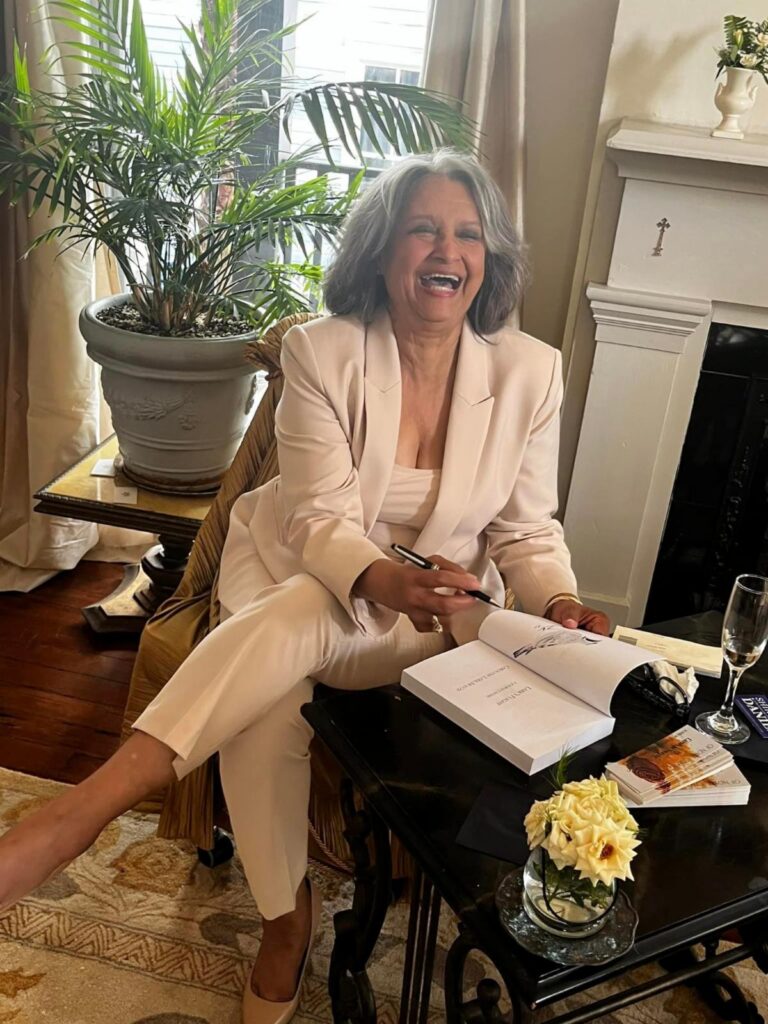
Lark’s Flight is the story chronicling the life of the author Carolyne Lark Swayze, raised during her formative years by her maternal grandparents, James and Rowena Lark. Beginning from the plantations of the Lowcountry of Georgia and South Carolina, the Larks would, for close to forty years, provide dedicated service to the Mennonite Church. Even as James became the church’s first Black bishop, the organization’s alignment with the Jim Crow laws of the Antebellum south belied any notion of racial egalitarianism, and under the hegemony of the Mennonite church, the Larks, as church planters, provided extensive service throughout the United States and Canada among urban Black communities, beginning in Chicago. But at what price?
The author addresses what she perceives as the masked pain of a family head-on and takes readers along on her journey of self-discovery, heeding the call that leads her back to where it all began and home.